
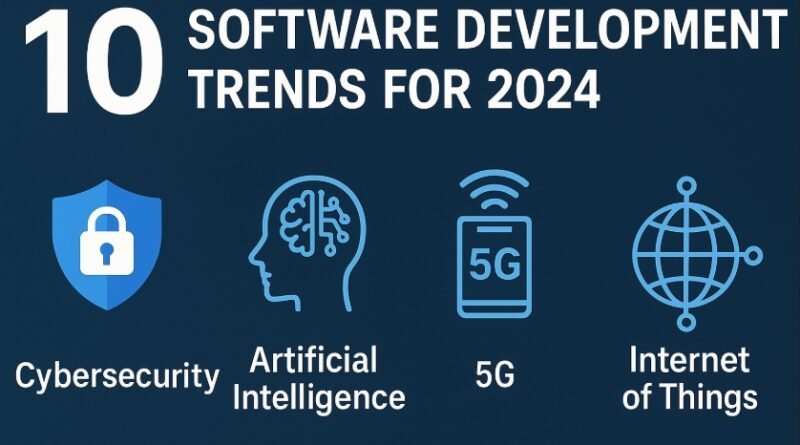
10 Software Development Trends for 2024: Cybersecurity, AI, 5G, and IoT
1. Artificial Intelligence and Machine Learning Dominate
Artificial Intelligence (AI) and Machine Learning (ML) continue to be the most significant drivers of innovation in software development trends 2024. AI tools are revolutionizing coding, debugging, and testing processes. For example, AI assistants like GitHub Copilot help developers write clean, efficient code in less time. Moreover, predictive analytics and natural language processing are becoming essential in enterprise solutions. As a result, more organizations are investing in AI-powered automation to boost productivity and decision-making in 2024.
2. Cybersecurity Takes Center Stage
With cyber threats increasing globally, cybersecurity is now a top priority. Consequently, companies are implementing zero-trust frameworks and AI-based threat detection systems. According to Cybersecurity Ventures, cybercrime costs could reach $10.5 trillion annually by 2025. Therefore, developers are focusing on building applications with “security by design” principles. This means software is now created with proactive protection against data breaches, ransomware, and phishing from the start.
3. 5G Technology Accelerates App Performance
The rollout of 5G continues to transform how applications are built and delivered. With faster speeds and lower latency, developers can now create ultra-responsive mobile and web experiences. In addition, 5G enables real-time gaming, cloud computing, and streaming at unprecedented levels. For instance, augmented reality and virtual reality apps greatly benefit from 5G’s capabilities. Therefore, the combination of 5G and edge computing in 2024 will dramatically enhance global connectivity and performance.
4. Internet of Things (IoT) Integration Expands
The Internet of Things (IoT) remains one of the most impactful software engineering trends. It connects billions of smart devices—from wearable fitness trackers to industrial sensors. Furthermore, IoT applications now integrate with AI and cloud platforms to process data in real time. For example, smart cities use IoT to monitor traffic and energy consumption efficiently. In 2024, the focus is shifting toward enhanced IoT security, better interoperability, and scalable architecture for large networks.
5. Low-Code and No-Code Development Platforms
As the demand for faster digital transformation grows, low-code and no-code platforms are becoming more popular. These tools allow businesses to create software using visual interfaces rather than traditional coding. Additionally, they reduce time-to-market and empower non-developers to build functional applications. Gartner predicts that by 2026, nearly 80% of software solutions will be developed through these platforms. Hence, this movement democratizes software creation and accelerates innovation across industries.
6. DevSecOps Becomes the New Standard
DevSecOps integrates development, security, and operations into a unified process. Traditionally, security was treated as a separate phase; however, in 2024, it is now embedded throughout the software lifecycle. Tools like Jenkins, Docker, and Kubernetes are evolving to support continuous security integration. Therefore, organizations benefit from faster releases with fewer vulnerabilities. In addition, automated compliance checks help maintain data integrity and meet regulatory standards efficiently.
7. Cloud-Native Development Grows Stronger
Cloud-native development continues to dominate digital transformation strategies. Instead of relying on traditional monolithic systems, companies now prefer microservices and container-based architectures. Moreover, platforms such as AWS, Google Cloud, and Azure offer flexible solutions that scale effortlessly. This trend ensures faster updates, greater reliability, and cost efficiency. Consequently, software development trends 2024 heavily emphasize building for the cloud from the very beginning.
8. Quantum Computing Enters the Scene
Quantum computing, though still developing, is rapidly influencing how we approach complex problem-solving. Major tech players like IBM, Microsoft, and Google are racing to make quantum technology commercially viable. As a result, developers are preparing for a future where encryption, simulation, and optimization are performed millions of times faster than before. In 2024, expect early adoption of quantum-ready frameworks and APIs for specialized applications.
9. Sustainable and Green Software Engineering
Sustainability is now a vital part of modern software engineering practices. Developers and organizations are focusing on creating eco-friendly code and optimizing infrastructure to minimize energy usage. For example, tech companies are investing in green data centers powered by renewable energy. Moreover, Google aims to operate entirely on carbon-free energy by 2030. Therefore, sustainable coding and efficient resource management are shaping a cleaner, greener software future.
10. Edge Computing and Real-Time Data Processing
Edge computing has emerged as a crucial trend, bringing computation closer to the data source. This reduces latency and enhances real-time responsiveness. Additionally, industries like healthcare, automotive, and telecommunications benefit significantly from this approach. Combined with 5G technology, edge computing enables instant analytics and faster decision-making. Consequently, businesses that embrace this innovation in 2024 will gain a competitive advantage in performance and security.
Final Thoughts on Software Development Trends 2024
In conclusion, 2024 is a landmark year for software innovation. Developers who embrace AI, 5G, IoT, and cybersecurity are setting new standards in performance and security. Furthermore, trends like sustainability, quantum computing, and low-code platforms are reshaping the future of development. Therefore, staying adaptable, informed, and forward-thinking is essential to thrive in this fast-paced digital era.